International Wildlife Crimestoppers: Engaging Communities To Deter and Apprehend Poachers

Lewis Rather

Lewis Rather

National Conservation Training Center, Shepherdstown, West Virginia--- Lewis Rather, retired Texas Game Warden with the Texas Parks and Wildlife Department, has no use for poachers.

“Poaching is very personal to me, it is stealing from every one of you and from me,” he told 42 African conservation officials attending the International Conservation Chief’s Academy (ICCA) to help build relationships and help fight illegal wildlife trafficking.

Following his retirement from the Texas Parks and Wildlife Department, after 35 years in wildlife law enforcement service, Rather became Executive Director of International Wildlife Crimestoppers, a 501(c) (3) non-profit corporation that helps to stop poaching wherever it occurs.  The organization originally began in 1997 in seven states, and now works internationally helping to reduce illegal wildlife trafficking by engaging communities in deterring and apprehending wildlife poachers.

The organization partners with conservation agencies and organizations to support the sustainable use of natural resources, and deter poaching around the world.  Its mission is to reduce the illegal take (poaching) of the world’s fish and wildlife resources through the exchange of information with anti-poaching organizations. “We all need to work together against poachers.” Rather said. 

The major emphasis of the organization is information, education, and apprehension.  People can call in with information on violations that then will be passed along to the agency handling enforcement of fish and wildlife laws.

Lieutenant Wayne Saunders, a 22-year veteran of the New Hampshire Fish and Game Department and former president of International Wildlife Crimestoppers, described how important it is for a game warden to develop a network of contacts with local people in the community.

“By building a network it allowed me to learn about who the poachers were, and that is essentially what Operation Game Thief does.  It helps provide information on poachers,” Saunders said.  “It is a network that provides information on poachers, and we want to expand the reach of this network – to a global scale.”

Operation Game Thief is an anti-poaching program that can be run in any state.  Operation Game Thief works alongside International Wildlife Crimestoppers to provide information that helps game wardens do their jobs effectively.  Times have changed and law enforcement needs to also change and adapt, and Saunders said that Operation Game Thief and International Wildlife Crimestoppers can help to give law enforcement critical, timely and accurate information on wildlife poachers.    

Each state has some community-based information-gathering tool to receive information on wildlife violations.  Sometimes it is an (800) number, sometimes a telephone tips hotline, or a Facebook page or texting.  Sometimes Saunders said that some of the best cases come from information provided by friends or ex-spouses.

Lt. Wayne Saunders.JPG

Operation Game Thief can be implemented either by a state natural resource department or by a non-profit conservation organization.  “We create an effective public relations campaign and pay out cash rewards,” Saunders said.  “Informants are allowed to remain anonymous.”

The amount of the payout depends on several factors, including whether the violator has had a prior conviction, the number of citations issued, the amount of the fine imposed by the courts, what civil restitution is required for the wildlife harvested illegally, and the involvement of the informant.

One of the tools used by the New Hampshire Department is to have a travelling trailer that contains a “Wall of Shame,” displaying mounted animals that were taken illegally.  The trailer is taken around the state to different events, and often draws the interest of young people.

One of the points of emphasis is youth education.  The program specifically reaches out to youth in order to have them understand the importance of wildlife laws, and the harm poachers do to wildlife.

More information on these programs can be found at:  www.wildlifecrimestoppers.org and www.operationgamethief.org.
Northeast Conservation Law Enforcement Chiefs Association Celebrates 75 years

On Monday, October 2, 2017, the Northeast Conservation Law Enforcement Chiefs Association (NECLECA) held their annual meeting in Stroudsburg, Pennsylvania at Trout Lake Conference Center. This marks the seventy-fifth anniversary of the inception of this organization.  For three days in August, 1942, the various law enforcement chiefs of fish and game agencies from the northeast states met to form an organization to enable them to formally discuss items of mutual interest.  The states of Connecticut, Delaware, Maine, Maryland, Massachusetts, New Hampshire, New Jersey, New York, Ohio, Pennsylvania, Rhode Island, Vermont and West Virginia were elected into membership.  At the first meeting, items of discussion included training, the sale and transportation of deer, undercover methods, cause and remedy of hunting incidents and equipment issues. 

During the most recent meeting, all the states mentioned above, except Ohio, were in attendance along with the State of Virginia and agents from the U.S Fish and Wildlife Service, and NOAA’s Office of Law Enforcement.  While the profession of a conservation law enforcement officer has expanded and become more challenging in the past 75 years, protecting the nation’s natural resources is still our core function.  During the current meeting of NECLECA, the chiefs heard presentations on traditional issues such as hunting related shooting investigations, exotic fish and wildlife sales, but additionally equipment discussions have developed into issues such as an in-depth training on body worn camera issues. 

NECLECA members

The new president of NECLECA, Major Chris Cloutier from the Maine Warden Service, stated “the purpose of the organization is to encourage and promote better law enforcement cooperation among the member states, exchange views and techniques and discuss problems relative to fish and wildlife law enforcement.  This statement was written 75 years ago and it still hold true today.  While the objective of conservation law enforcement is to protect fish and wildlife our officers now enforce boating and marine fisheries laws, perform search and rescue operations and have homeland security responsibilities. Our officers are the most dedicated, well trained and passionate of any law enforcement profession.”

More People and Ever Expanding Responsibilities in New Hampshire

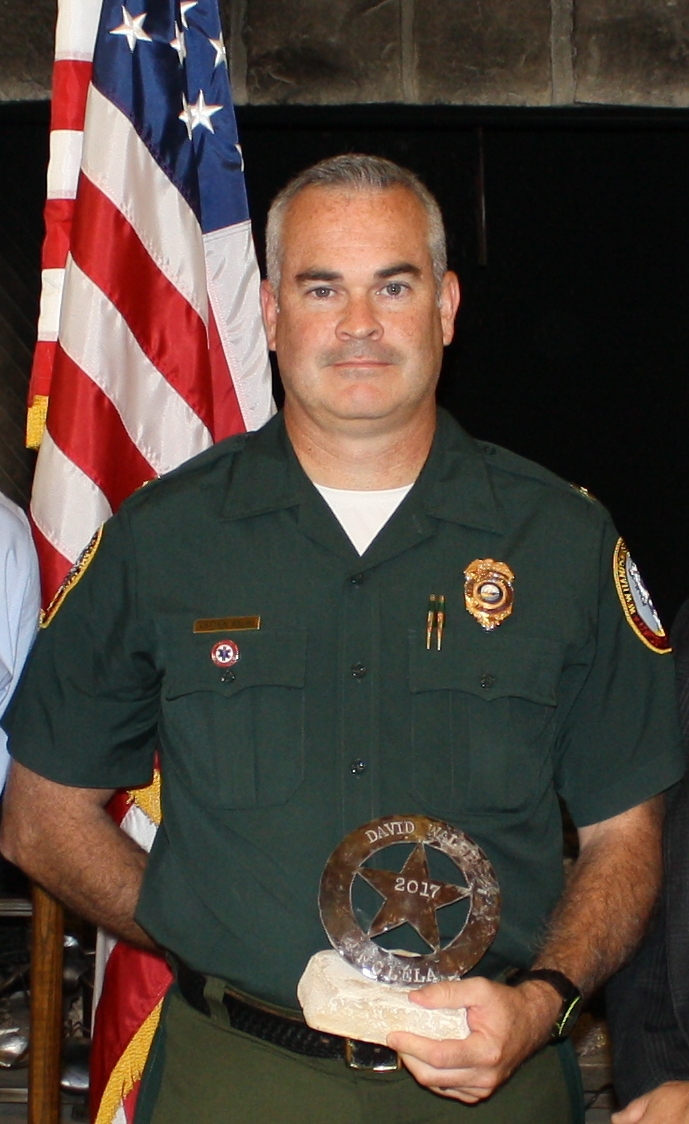
Officer David Walsh, New Hampshire Fish and Game Department

Officer David Walsh, New Hampshire Fish and Game Department

In 1950 there were 38 conservation officers in New Hampshire. The state’s population was half a million.

Today the state population has nearly tripled to 1.4 million, and tourism has increased from nearby population centers of Boston, Baltimore and New York. Snowmobiling is popular. ATV use is exploding. They have added spring and fall turkey seasons to enforce. They have a limited moose season now.

They still have only 38 conservation officers.  David Walsh, 44, is one of those officers.  He’s a 19 year veteran, currently a lieutenant with the New Hampshire Fish and Game Department.  Considering weekend duty and vacations that usually means there are about 15 wardens in the field on any given day in New Hampshire.

Hiking is extremely popular in the state, both in mountain areas and on the Appalachian Trail, which passes through the state. Helping people who have become injured or lost while hiking in remote areas is a now a major part of their work load, a “partially funded” mandate, he said. ATV use is the fastest growing outdoor sport, again requiring search and rescue from wardens. A dollar from the ATV registration fee goes to search and rescue, but most years that falls about $200,000 short of what they spend on ATV-related rescues. Hikers can fill out a voluntary hiking card that brings in about $60,000 annually to the department.

Meanwhile, they still have to perform their traditional job of regulating hunting and fishing. “We definitely spend more of our time now on the non-consumptive user than the consumptive user,” he said.

The number of hunters in the state has dropped slightly in recent years. The number of fishing licenses have remained the same.  They have 14 miles of coastline.

Wild turkeys were reintroduced to the state in the 1970s and 1980s and are doing well. They now have spring and fall turkey seasons.  They have moose – more than Vermont, fewer than Maine, he said.

They started a moose hunting season in the mid 1980s.  At its peak they were issuing over 600 moose permits per year. In recent years they have been issuing around 50.  Moose numbers have dropped, probably related to stress caused by winter ticks, he said.  The trend in milder winters has been helping the ticks.

The focus of the International Conservation Chief’s Academy has been on preventing wildlife tracking. Walsh suspects there is reptile trafficking going on and possibly other trafficking, but they don’t have the manpower to investigate it, Walsh said.  “To really get a handle on that, in my, opinion, you need a covert operation. That means extra staff, extra training,” he said.

Given the demands on the 38 conservation officers, the state Legislature would have to prioritize wildlife trafficking and allocate additional funding in order for us to effectively to pursue wildlife traffickers, he said. 

Walsh grew up near Boston, but spent summers as a youth in New Hampshire.  After a chance meeting with a warden at age six, he decided this was something he might like to do.  It’s been a great career, despite some obvious challenges.  “There is a different challenge every day, and a conservation officer's office is in the woods,” he said.   Walsh encourages young people to consider a career in conservation law enforcement.

Protecting Resources: the Wildlife Violator Compact

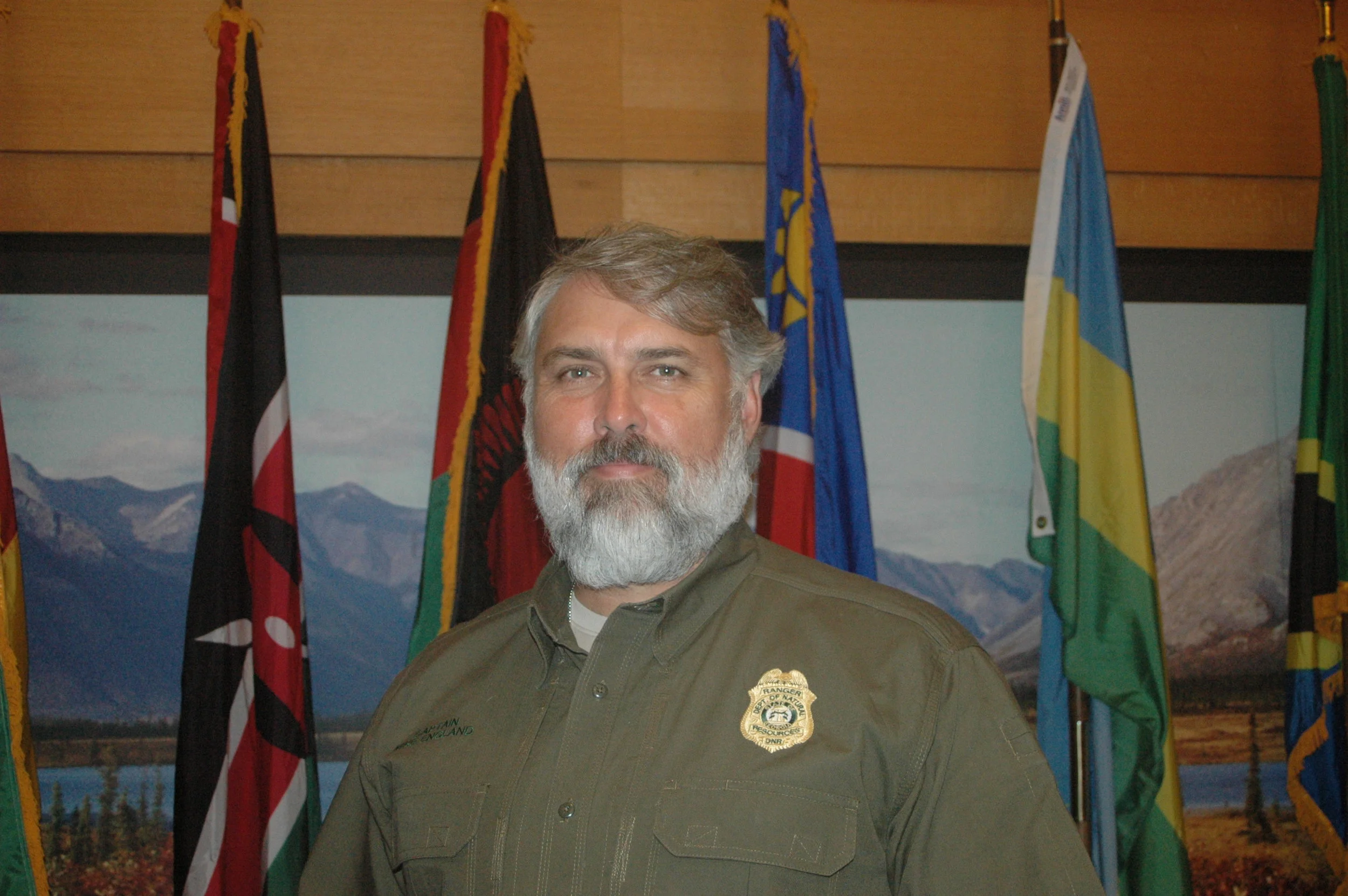
Mike England

Mike England

National Conservation Training Center, Shepherdstown, West Virginia---Hunters and anglers who have had their license privileges taken away in one state are also out of luck if they want to hunt or fish in 45 other states.

That is because 45 states have adopted the Wildlife Violator Compact, which is a pro-active approach to deter violators from hunting and fishing in other states when their license privileges have been revoked in their home state.

Mike England,  a Captain in the Law Enforcement Division of the GeorgiaDepartment of Natural Resources told 42 African conservation officials attendingtheInternational Conservation Chief’s Academy (ICCA)  that the Violator’s Compact was modeled after the Driver’s License Compact, where a suspended license in one state is honored by other states.

“The idea began in 1985 when Nevada and Colorado agreed that they didn’t want violators from the other state to be hunting in their state, and then in 1989 Oregon joined and created a formal program,” England said.

By 2003 all of the western states were members of the compact and today 45 states are members. Nebraska will become the 46th state to join the compact effective November 7, 2017 and New Jersey will become the 47th state to join the compact effective December 1, 2017.

“Today, every state other than, Hawaii, Delaware, and Rhode Island have joined the Compact,” England said.

The requirements are that the state must provide legal authority, by passing a law or resolution in the legislature, giving authority for the state to participate.  The state then agrees to comply with the rules of the Compact and sends an agreement to the chair of the Wildlife Violator Compact.

The Compact keeps a database of revoked privileges to hunt and fish.

“The Compact is important because of the mobility of law violators in order to protect and manage our wildlife resources for the benefit of all sportsmen,” England said.

The Compact also provides a strong incentive for a violator who receives a ticket but does not show up for court to pay up for their violation to appear in court or post bond.  If they do not show up in court or pay their violation, the compact can suspend their license.  Once the person posts bond, that can then be removed.

The Compact also benefits states by allowing reciprocal recognition of license suspension, and allows conservation officers to stay in the field enforcing laws rather than having to take a non-resident violator to the local courthouse.  

Screen Shot 2017-10-06 at 10.53.05.png

Adapting the North American Model of Conservation to New Realities

Passenger pigeons were once so abundant in North America that their flocks blocked the sun for days as they passed. Individual flocks may have numbered up to 12 billion. The North American population may have numbered as many as 50 billion.

“We killed them all,” said Shane Mahoney, an authority on wildlife who has written extensively for both popular and academic publications.

Shane Mahoney

Shane Mahoney

Mahoney spoke to an audience that included wildlife officials from 17 African nations and state and federal conservation wardens from about 30 states on the “North American Wildlife Model” – how wildlife in North America have been managed.

He acknowledged that these methods may not be the best for every country. “No single model or approach to natural resources is going to meet every circumstance,” he said.  

There is global concern for population declines among several species of African wildlife, including elephants, lions and rhinoceroses, but by the late 1800s many North American species had been reduced to much smaller populations, mostly because of commercial exploitation. As rail lines were built it became easier to ship wildlife to eastern markets.

Bison were reduced from 20 or 30 million animals to less than 100.  Elk were reduced to a small population in Yellowstone National Park where they had to be guarded by the U.S. Cavalry to keep poachers from killing what remained. Wild turkeys were down to a few thousand.

The key to ending the downward spiral was to stop the commercial sales of wildlife for meat and feathers.

“A minority of people rose to care about wildlife, and rose against impossible odds,” he said.

Teddy Roosevelt and a small number of influential men were able to get laws passed protecting wildlife. They were supported by sport hunters and by women who spoke against a fashion trend of the day where women’s hats were decorated with egret feathers. Egrets and other large wading birds were nearly hunted to extinction for their feathers.

We were unable to save the passenger species, but the good news is that many species made remarkable recoveries.

Wild turkeys, Canada geese, white-tailed deer and elk are now abundant, as are egrets and herons.

In 1916 the U.S. and Canada signed the Migratory Bird Treaty Act, protecting birds that migrate through both countries and allowing for the joint management of hunted species such as ducks and geese.

The rising acceptance of science led to more scientific methods of wildlife management, although Mahoney acknowledged that the current emphasis on science in management may be coming at the expense of traditional, local “deep knowledge.” “It’s not enough to have fancy radio collars,” he said.

Some African wildlife officials had similar concerns that traditional knowledge is being ignored and lost in today’s wildlife management.

Mahoney acknowledged that there was a cultural extinction in North America with languages and cultural traditions, including wildlife knowledge was lost as white settlement advanced quickly westward.

Canada is currently involved in a process where about half of the land in the country will be jointly managed by the Canadian government and First Nations, Mahoney said.

Another criticism of the North American model is that it focuses too much on large animals popular with hunters. Mahoney conceded that the current model of wildlife protection was primarily founded by hunters, but it was not the intention to protect only hunted species. Teddy Roosevelt, who did more to protect wildlife and wild places in North America than anyone, was an avid bird watcher as well as a hunter, he said.  While all Americans contribute to national parks and wildlife to some degree through taxes, sport hunters have been a major source of funding for wildlife and for the law enforcement that protects wildlife through license fees and through excise taxes placed on sporting equipment and ammunition in the 1930s, he said.  Wild areas purchased with funds from hunters have benefitted a variety of wildlife, not just hunted species, he noted.

Mahoney notes that the percentage of the North American population who hunt and buy licenses or duck stamps is declining, and North America will need to find new ways of paying for wildlife in the future.

Today North Americans are increasingly living in urban areas and getting away from the lifestyle that led to the North American model, yet a fascination with wildlife persists. We now have talking lizards selling insurance on the television.

“All of us, great ready for a brave new world,” he advised.